ここから本文です
TWO:Hello, Sandy! How are you, Dick? Larry met the returning chums as they climbed to the small estate wharf from the yacht tender, and while they strolled up the path he asked eagerly:

Hydrocyclone (liquid cyclone)01

Hydrocyclone (liquid cyclone)02

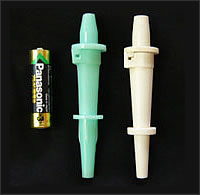
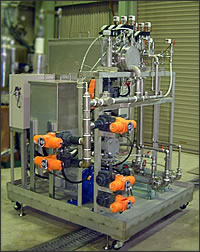
A hydrocyclone (liquid cyclone) injects treatment solution into stationary equipment to perform separation, classification, and concentration, and is an innovative separator with a very simple structure and no drive unit.

Structure of a hydrocyclone (liquid cyclone)

A suspension containing fine particles of several micrometers or more is supplied to a cylindrical container circumferentially at high speed. And as a result it starts to rotate and a centrifugal force is generated. At this time a gravitational acceleration of several tens of thousands of G is generated in the circumferential direction, and thus leading to fast sedimentation and concentration of the fine particles. The separated concentration can be freely selected by changing the supply rate (supply pressure and flow rate) and the flow ratio of the outlet. Our hydrocyclone (liquid cyclone) was designed and manufactured to classify and concentrate fine particles, and so has a small element.

THREE:Besides the miscellaneous poets, the dramatic ones numbered Congreve, Vanbrugh, Farquhar, Colley Cibber, Nicholas Rowealready mentionedSavage, Lansdowne, Ambrose Philips, and others. In many of the plays of these authors there is great talent, wit, and humour, but mingled with equal grossness. Congreve's dramas are principally "The Old Bachelor," "The Incognita," "The Double Dealer," "The Way of the World," comedies, and "The Mourning Bride," a tragedy. Vanbrugh, the celebrated architect, produced "The Relapse," "The Provoked Wife," "The Confederacy," "The Journey to London," and several other comedies. Farquhar's principal plays are "The Beaux's Stratagem," "Love and a Bottle," and "The Constant Couple." Savage was the author of the tragedy of "Sir Thomas Overbury;" Nicholas Rowe, of five or six tragedies and one comedy, the most popular of which are "The Fair Penitent" and "Jane Shore." Rowe also translated Lucan's "Pharsalia." As for Colley Cibber, he was a mere playwright, and turned out above two dozen comedies, tragedies, and other dramatic pieces. Lord Lansdowne was the author of "The She-gallants," a comedy, and "Heroic Love," a tragedy of some merit; and John Hughes wrote "The Siege of Damascus," a tragedy, which long remained on the stage.
  • Equipment costs can be reduced.
  • Operating costs can be reduced.
  • Maintenance costs can be reduced.
  • Any change in raw material and product can be easily addressed.
  • Large amounts can be treated in a small area.
  • Separation and cleaning are easy because of the simple structure.
  • Simplified control
  • This equipment can be operated in synchronization with external devices.
  • Alarm and interlock mechanism.
THREE:The violent discontent with the conduct of Bute and his Ministry gave considerable strength to the Opposition, at the head of which now stood Pitt, supported by Lord Temple and the Duke of Newcastle. George Grenville, not satisfied with the terms of the peace, resigned the post of Secretary to Halifax, and took his new one at the head of the Admiralty; and Henry Fox, Paymaster of the Forces, became the leader of the Commons. The Duke of Devonshire and the Marquis of Rockingham also resigned their places in the royal household; and the king, in his vexation, striking Devonshire's name out of the list of Privy Councillors, the Duke's kinsmen, Lords George Cavendish and Bessborough, also resigned.Such were the difficulties which Ministers had to contend with for commencing the war at sea. In one particular, however, there was more liberality; money was ungrudgingly voted; the land-tax was raised from two to four shillings in the pound, and the Sinking Fund was so freely resorted to, that the supplies altogether amounted to upwards of four millions. During these discussions, news came on the 13th of March, that on the 21st of November, 1739, Admiral Vernon had taken Porto Bello from the Spaniards. This was good news for the Opposition, for Vernon was one of their party, and a personal enemy of Walpole. There were great rejoicings and the Lords sent down an address of congratulation to the king, for the concurrence of the Commons. Yet in this they could not avoid making a party matter of it, the address stating that this glorious action had been performed with only six ships, and thus to mark[73] the contrast with the doings of Admiral Hosier in those seas, and so to blacken his memory. The address was carried in a thin House, but only by thirty-six against thirty-one, so that along with the news went the comment to Vernon, that the Ministry begrudged him his glory. Parliament was prorogued on the 29th of April, 1740, and the king set off on his summer visit to Hanover.
  • Classification and concentration for the manufacture of inorganic powder materials
  • Classification of ceramic materials
  • Removal of fine particles, including iron powder
  • Removal of fine particles from pigments
  • Removal of fine organic particles from solvents
  • Separation of starch and yeast
  • Removal of fine particles from high-temperature strong acid solutions
  • Removal of fine particles from low-temperature solutions